SFO “elected” to pay for DHS facial recognition system
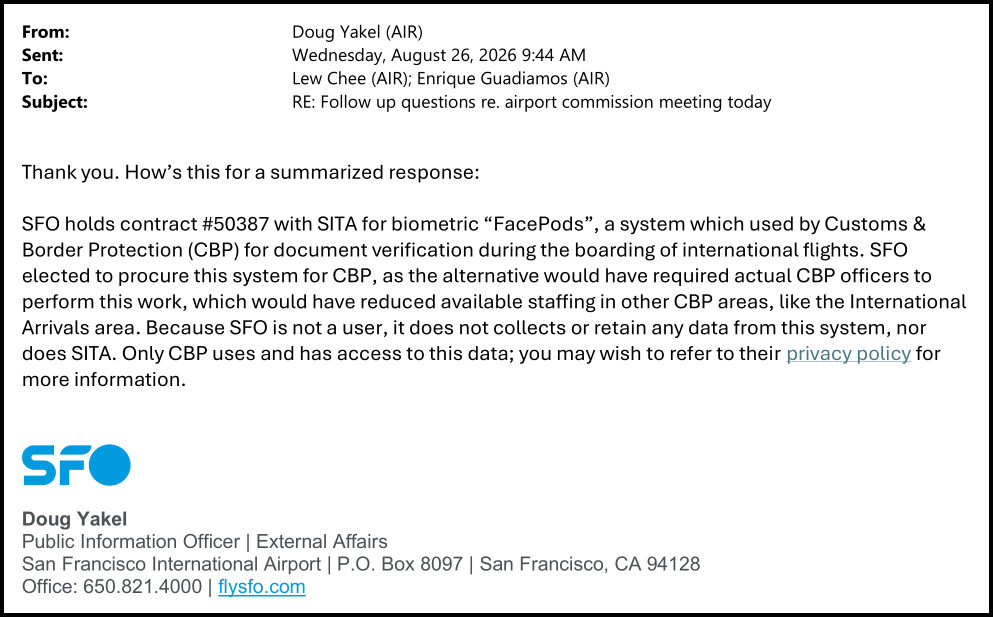
[Internal SFO email message released in response to our public records request. The claim that only CBP has access to the facial images is false. The official CBP notice for these records indicates that they are routinely shared with other DHS components, which include ICE, and with other US and foreign agencies.]
The last scheduled Airport Commission meeting was canceled. We’ve received no response to any of our specific requests for action by the Airport Commission. In the meantime, though, we’ve received responses to some of our requests for airport records which confirm the illegality of some of the airport’s actions and the need for action.
Internal SFO email messages show that SFO officials illegally “elected” to pay for facial recognition cameras connected to to the DHS Traveler Verification Service, in order to spare US Customs and Border Protection officers from having to photograph departing international passengers and free up CBP officers to spend more time on other duties at the airport — duties which include assisting ICE officers with detentions of travelers and other immigration enforcement activities.
According to one internal SFO message summarizing information provided by airport operations managers:
SFO holds contract #50387 with SITA for biometric “FacePods”, a system which used by Customs & Border Protection (CBP) for document verification during the boarding of international flights. SFO elected to procure this system for CBP, as the alternative would have required actual CBP officers to perform this work, which would have reduced available staffing in other CBP areas.
Facial images taken by these city-funded cameras are transmitted over a city-funded connection to CBP. CBP shares them with other DHS components including ICE, and uses them to train the facial recognition algorithm used by ICE to determine who to detain or deport.
When this system was first tested, CBP officers staffed the cameras. But CBP has since tried to get airports to provide the cameras and and airlines to operate them. Airlines are incentivized to collaborate in this passenger surveillance and control scheme by being given free use of the TVS system (paid for, in this case, by SFO) for their own business process automation and commercial surveillance.
Pursuant to San Francisco’s Sanctuary City Ordinance, city and county agencies such as the airport may not “elect” (i.e choose) to provide or pay for services to support immigration enforcement. City funds may be spent on such services not as a voluntary choice but only to the extent required by Federal regulations.
Federal regulations (8 CFR §234.4) require each international airport to pay for some services and facilities for use by Federal immigration enforcement agencies, including “such temporary detention quarters as may be found necessary.”
SFO Airport Director Mike Nakornkhet and S.F. City Attorney David Chiu wrote to CBP earlier this month to “express concern” about CBP’s treatment of detainees at SFO. But this focuses attention on precisely that aspect of immigration enforcement at SFO over which the city has the least control. This makes it easy for city officials to claim that their hands are tied — as they are, to some degree, with respect to the immigration jail at SFO.
But not everything Federal agencies ask the airport to provide is required by Federal regulations. The Airport Director, the City Attorney, and the Airport Commission should focus on the decisions within their control: voluntary financial support by SFO for facial recognition infrastructure and services used for immigration enforcement, and signage to warn travelers about the invisible risks of airline-TSA-ICE data sharing.
No Federal regulation requires any airport to provide, or any airline to use, the TVS facial recognition system. The notice of CBP’s regulations for use of facial recognition for departing air travelers makes explicit that, “Participation in CBP’s biometric entry-exit program will remain voluntary for carriers under this final rule. If air carriers or airports do not participate, they will continue conducting manual identity verification.”
TVS is a choice for the airport — a choice that the Sanctuary City Ordinance prohibits SFO to make. Voluntary funding of immigration enforcement activities by any agency of the City and County of San Francisco, including the airport, is forbidden.
SFO’s contract #50387 with SITA is a voluntary payment for services that are used for immigration enforcement. As such, it is prohibited by the S.F. Sanctuary City Ordinance. It is the legal duty of the S.F. Airport Commission to terminate this contract immediately. We reiterate our demand that the Airport Commission place the termination of contract #50387 on its agenda for action at its next meeting.
Why wasn’t this illegality noticed before this contract was negotiated and approved?
The records released in response to our requests show that airport officials know there’s an alternative: the city could make CBP do its own dirty work. If sending CBP officers to departure gates reduces the number available to back up and assist ICE agents elsewhere in the airport where travelers are being kidnapped, that would be a benefit.
The fact that this flagrantly illegal contract was negotiated by airport staff and approved by the San Francisco Airport Commission is indicative of a systemic failure by SFO to pay attention to its obligations pursuant to the S.F. Sanctuary City Ordinance.
Although an unspecified quantity of records has been withheld from release in response to our requests under California public records law and the S.F. Sunshine Ordinance, none of the records released to date indicate that there is any protocol for review by SFO or the City Attorney of contracts — even those with or providing services to DHS components — to assess whether the services to be provided are actually required by Federal regulations. Contracts are routinely assessed for compliance with other laws, but not for complinace with the Sanctuary City ordinance. This needs to change.
The connection of TVS cameras to CBP and other DHS components, and the lack of a legal mandate for this system, have also escaped scrutiny because of the absence of the signage required by Federal law, CBP policy, and the contract between SFO and CBP.
The records released by SFO in response to our requests include an agreement signed by SFO and CBP, pursuant to which the airport promised to post signs at all departure gates where TVS is in use. This agreement specifies the minimum number and size of these signs and requires that they include CBP’s standard messaging.
So far as we’ve been able to determine on our visits to SFO, these signs are entirely absent from many, perhaps all, of the gates at the “domestic” terminals at SFO that are also used for international departures and where TVS facial recognition is in use.
Airline staff at these gates have been trained in “biometric boarding” as an airline procedure, not an outsourced immigration enforcement role. In the absence of proper (or any) signage, some of the airline staff operating these cameras for CBP were unaware, until we told them, that the facial images they are collecting are being used to build the gallery of photos used by ICE to identify and target non-U.S. citizens to detain or deport.
Even at the international terminal at SFO, where some signs with the CBP’s messaging are posted, those signs fail to comply with Federal law. As the Identity Project and allied organizations pointed out in our comments on the proposed CBP regulations, none of the CBP signs include the OMB control number and other notices required by the Paperwork Reduction Act (PRA) for any collection of information by or on behalf of a Federal agency.
Many more U.S. citizens would opt out of “biometric boarding” if they knew that they could opt out and if they knew that the images collected by airlines would be used to train the ICE immigrant-detection facial recognition algorithm. In our experience, human passport checks are significantly quicker than TVS facial recognition. So everyone waiting to board the plan befits each time someone opt out of “biometric boarding”.
In addition, in the absence of proper notices the PRA (44 U.S.C. §3512) creates an absolute defense for anyone — regardless of citizenship — against any penalty for not providing requested information, including not submitting to airport mug shots.
There are similar problems of lack of awareness and need for warning signs about the use of airline reservations for domestic flights for immigration enforcement.
In November and December of 2025, we reported on incidents at SFO and other airports that suggested that the TSA was passing information from reservations for domestic flights to ICE to use to track and target travelers for detention or deportation. We inferred that this meant the TSA had started sharing Secure Flight passenger data with ICE. Ten days after our second article, it was confirmed by the New York Times.
But SFO officials weren’t paying attention to this news, despite its critical importance to the safety of travelers, especially domestic travelers, at SFO and other airports.
A thread of text messages between top SFO managers released in response to one of our public records requests shows that as of late March 2026, months after the use of domestic flight data by ICE was confirmed, SFO airport director Mike Nakornkhet was seemingly unaware that this was happening, when it had started, or how the data was getting to ICE:
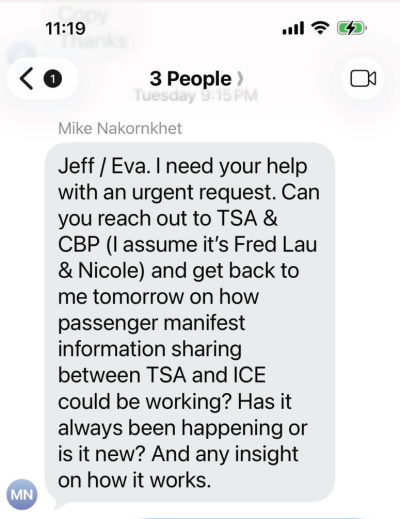
If the Airport Director didn’t know about this threat, months after it was reported, how can ordinary travelers be expect to know — unless the airport posts signs to warn them?
SFO officials have said they lack the authority to “regulate” ICE. But as the owner and landlord of the airport, the city has the authority to post whatever signs it wants.
Travelers are being targeted and intercepted by ICE at SFO and other airports because they don’t know that information about their domestic air travel plans can be shared with ICE in advance of their flights. SFO could and should do everything it can to warn them, starting with prominent notices on shared-use check-in kiosks and in all check-in areas, especially those for domestic flights where the threat is less well known: “Warning: Information you provide to airlines, even for domestic flights, will be shared with ICE in advance of your flights, and can be used to target you for ICE detention or deportation.”
Join us at the San Francisco Airport Commission meeting on October 20th (9 a.m., S.F. City Hall, Room 400). Members of the public get two minutes each to speak during the public comment period at the end of the meeting. If you can’t make it in person, send your comments to “AirportCommissionSecretary@flysfo.com“.