OK legislators sue to block upload of state residents’ data to AAMVA’s national REAL-ID database
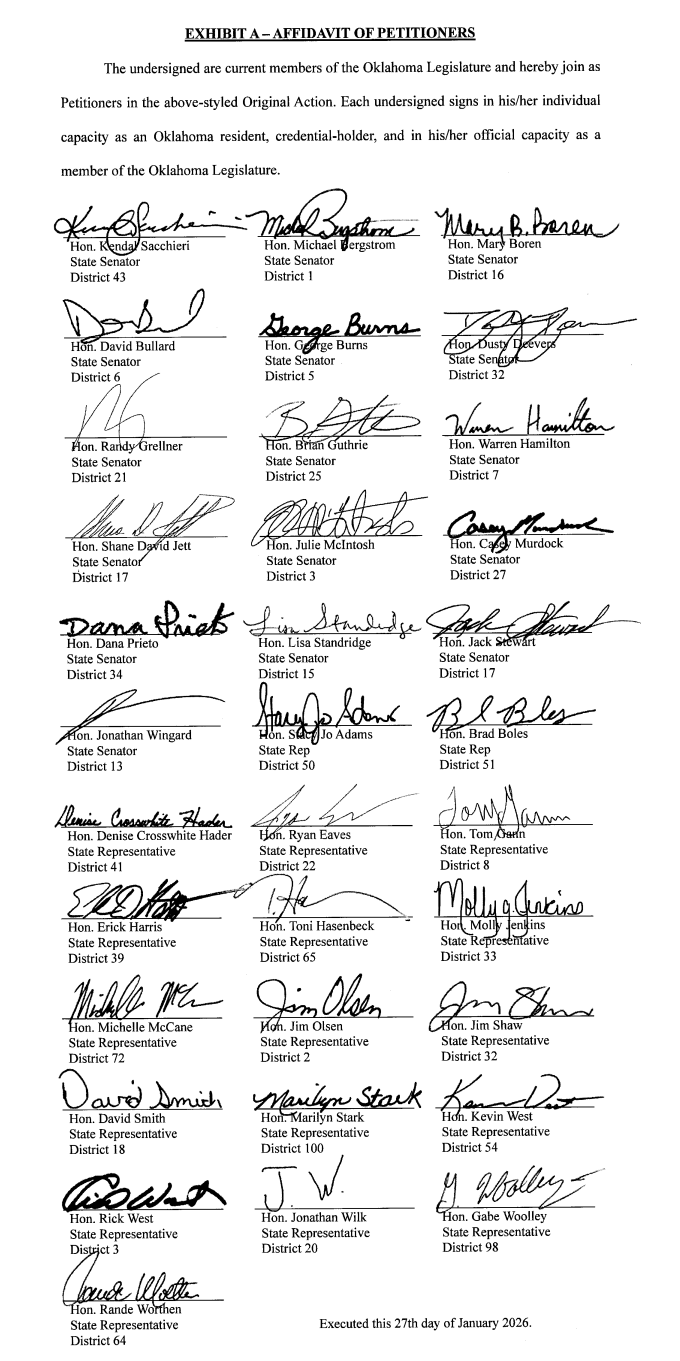
Today a bipartisan group of thirty-four members of the Oklahoma state legislature petitioned the Oklahoma Supreme Court to block the upload of information from all Oklahoma drivers licenses and ID cards to the SPEXS national REAL-ID database operated by the American Association of Motor Vehicle Administrators (AAMVA).
The petitioners, led by Sen. Kendal Sacchieri (R-Blanchard), include sixteen members of the Oklahoma Senate and eighteen members of the Oklahoma House of Representatives. They are represented by Oklahoma City attorney Wyatt McGuire.
Service Oklahoma, the agency that issues drivers licenses and state ID cards, plans an initial bulk upload of data about all Oklahomans to the SPEXS database over the Presidents’ Day weekend of February 14-16, 2026, unless the upload is blocked by the state Supreme Court or suspended or postponed by Service Oklahoma or Gov. Kevin Stitt.
The state legislature convenes for its next session February 2nd, and multiple steps are required before a bill can be enacted. Unless the bulk upload to SPEXS is cancelled or postponed, it will take place just before the legislature can take any action to stop it.
We don’t know whether the upload was scheduled deliberately to preempt the possibility of legislative oversight. But we’ve seen the same pattern in other states where governors and/or driver licensing agencies arranged to join the the SPEXS database and the misleading-named “State to State” (S2S) network — in which data is transmitted through AAMVA, not directly between states — just before the start of a session at which the legislature might have questioned or taken action to stop the upload.
In Alaska, for example, the Department of Administration carried out its initial bulk upload of state residents’ data to SPEXS over the weekend of January 28, 2017, just days after the start of the legislative session and just before hearings were scheduled on legislation to block the upload.
Like many other states, Oklahoma offers residents a choice of a REAL-ID Act “compliant” or “non-compliant” drivers license or state ID card. Many people choose a “noncompliant” license or ID specifically because they want their data kept in-state. But in order for a state to join S2S, AAMVA’s rules — not any law — require it to upload information about all drivers licenses and state IDs, including “noncompliant” ones, to AAMVA’s national SPEXS database.
Sen. Sacchieri introduced a resolution in the Oklahoma state legislature last year to reaffirm that information about Oklahoma residents who apply for a drivers license or ID that doesn’t comply with the REAL-ID Act may not be sent out of state or to the national REAL-ID database. But that bill didn’t get a vote in 2025, and any action by the state legislature in 2026 won’t take effect until after the planned February 14-16 upload.
As the legislators point out in their brief to the state Supreme Court, Oklahoma law, 47 O.S. § 6-110.3a(A)(C), already prohibits sharing personal information about drivers license or ID card applicants except as required by the REAL-ID Act. As the legislators also point out, the Federal REAL-ID Act does not (and cannot) require states to take any action. Whether to “comply” is a choice for each state to make.
Once personal information is uploaded to SPEXS, it is out of the state’s control. The Federal government could use a subpoena or other legal process to order AMMVA, as a private entity, to hand over SPEXS data and not to disclose the subpoena to the state. No state that participates in SPEXS can really know whether AAMVA has already chosen or been compelled to hand over data about its residents to Federal agencies, or for what purposes.
The thirty-four Oklahoma state legislators joining the petition have asked the state Supreme Court to stay and temporarily enjoin the upload of Okahomans’ data to SPEXS pending consideration of their lawsuit. Their complaint is rooted in the separation of powers and the authority of the legislature: No Oklahoma law authorizes the upload, no funds have been appropriated for it, and it contravenes the intent of the legislature as expressed in current Oklahoma law.
The fact pattern in Oklahoma is typical of what has happened in other states that have uploaded their residents’ personal information to SPEXS without advertising their plans or seeking explicit legislative authorization or funding for joining the national database.
After we were the first to report on the SPEXS database, AAMVA removed the specifications for the database from their public website, and threatened to sue us to get us to take down the legal copy of the specifications we had posted. AAMVA is a private entity with no legal authority, but it acts like a lawless, rogue government agency. What AAMVA and its Federal and state allies fear most is informed public debate and legislative oversight.
AAMVA, the Federal government, and their state allies don’t want you know that there is a national drivers license database, much less any details about the database or AAMVA.
We look forward to a ruling by the Oklahoma Supreme Court that will allow the Oklahoma legislature time to exercise oversight over Service Oklahoma and encourage legislators in other states to exercise their rightful authority over state agencies’ relations with AAMVA.
It all ties into the larger global plan to force digital ID on everyone.
Oklahoma Supreme Court asked to halt driver license data transfer to national system (by Anthony Kimery, Biometric Update, January 29, 2026):
https://www.biometricupdate.com/202601/oklahoma-supreme-court-asked-to-halt-driver-license-data-transfer-to-national-system
Order by the Supreme Court of Oklahoma, January 29, 2026:
“Respondents Service Oklahoma and Executive Director Jay Doyle are directed to respond to Petitioners’ request for an emergency stay and temporary injunction by no later than Tuesday, February 3, 2026… The Court will seek briefing from the Respondents on the merits of Petitioners’ application to assume original jurisdiction after consideration of Petitioners’ request for an emergency stay.”
https://www.oscn.net/dockets/GetDocument.aspx?ct=appellate&bc=1064375412&cn=MA-123760&fmt=pdf
“Oklahoma and New York Implement S2S Services” (AAMVA press release, 2/18/2026):
https://www.aamva.org/publications-news/aamva-news/oklahoma-and-new-york-implement-s2s-services
https://images.magnetmail.net/images/clients/AAMVA//attach/OKTWIR_S2SGo_Live.pdf