Jun 27 2026

California legislature agrees to upload driver’s licenses to national database

Withdrawing its opposition under behind-the-scenes pressure from Gov. Gavin Newsom and lawless threats from the US Department of Homeland Security (DHS), the California legislature has agreed to fund and revise state law to authorize the upload of information about all driver’s licenses and ID cards issued by the state to the private SPEXS national ID database operated by the American Association of Motor Vehicle Administrators (AAMVA).

The budget compromise between Gov. Newsom and the legislature announced last night includes “guardrails” intended to give an illusion of protection for license and ID data.

There’s no time before the hearing on the budget compromise scheduled for Monday morning in the Senate Budget Committee for legislators to assess whether those guardrails will be effective. But to anyone aware of the real threat, it’s apparent that they are a sham.

That was inevitable, as we’ve pointed out in our previous statements to the legislature.

Once this data is transferred to AAMVA, components of the DHS or other Federal or state law enforcement agencies will be able to obtain it from AAMVA by court order. Such a subpoena or warrant could, and probably would, include a gag order prohibiting AAMVA from disclosing it to the state of California or to the individuals whose data is disclosed.

Even after the fact, neither California nor individual Californians will know that this has happened or be able to challenge it.

That data could be misused in many ways, but it’s especially likely be weaponized against  immigrant and transgende Californians who are already being targeted by Federal agencies and other states.

The summary of the proposed transportation budget trailer bill (AB 169) released last night says that it “Limits data sharing to only that required by federal law.” But that’s not true. “Compliance” with the REAL-ID by California or any other state is optional, not required. Neither the Federal REAL-ID Act nor any other Federal law requires, or could require, California or any other state to share any data with AAMVA, a private nonprofit corporation.

As we pointed out in our earlier testimony on the budget proposal,  California has a choice. The state could and should say “No” to premature capitulation to DHS threats.

The Legislature should reject this “compromise” sell-out. Instead, the state, through its Attorney General, could and should prepare to defend Californians against any interference by the DHS or Transportation Security Administration (TSA) with our right to travel.
Jun 24 2026

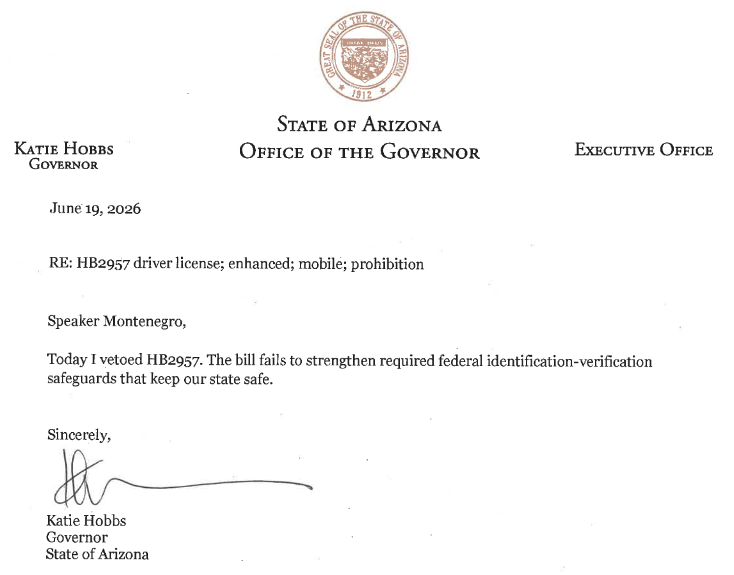
Arizona governor vetoes bill to end REAL-ID compliance

Arizona Governor Katie Hobbs has vetoed  a bill which would have ended the state’s compliance with the Federal REAL-ID Act.

Like many other states, Arizona gives applicants for driver’s licenses or non-driver IDs two options: a “travel ID” that is issued in accordance with procedures that satisfy the requirements of the REAL-ID Act, or a non-compliant “non-travel” license or ID that is valid for driving or other state purposes but isn’t valid for Federal purposes.

HB2957 would have required the Arizona Department of Transportation to continue to offer this option of driver’s license and IDs that don’t comply with the REAL-ID Act. HB2957 would have added the requirement that information about these noncompliant licenses and IDs and the Arizona residents who choose them not be shared with other states and not be “stored in any interstate, federal or international database system, including the state pointer exchange services” (SPEXS), the national ID database hosted by the American Association of Motor Vehicle Administrators (AAMVA).

Since 2024, Arizona has been sharing the contents of its database of both “travel” and “non-travel” licenses and IDs with other states, and has uploaded excerpts from each  license of either type — compliant or noncompliant — to the SPEXS national ID database.

The point of HB2957 is to end this practice. People who choose a non-compliant license or ID think they have opted out of the national data sharing and national ID database that is the goal of the REAL-ID Act. To make that opt out real, HB2957 would have required Arizona to discontinue uploads of data about noncompliant “non-travel” Arizona licenses and IDs to SPEXS.

But AAMVA requires a state that wants to participate in SPEXS  to upload data about all licenses and IDS the state has issued, regardless of whether they are issued in accordance with REAL-ID Act procedures.

Even if AAMVA — a private nonprofit corporation not subject to any of the decision-making rules applicable to state or Federal government agencies —  decided to change its rules, allowing state residents to opt out of national sharing of their license data would render all licenses issued by that state noncompliant with the REAL-ID Act.

The REAL-ID Act requires that, “To meet the requirements of this section, a State shall… Provide electronic access to all other States to information contained in the motor vehicle database of the State [and] maintain a State motor vehicle database that contains, at a minimum… all data fields printed on drivers’ licenses and identification cards issued by the State.”

If a state withholds data about some licenses and IDs from this data sharing, that state won’t be in compliance with the REAL-ID Act. And for a license or ID to be “compliant”, it must both be (1) issued in accordance with compliant [procedures and (2) issued by a compliant sate. If the state as a whole is noncompliant, none of the licenses or IDs it issues will be compliant, regardless of what issuance procedures are followed.

HB2957 was approved by both chambers of the Arizona legislature by substantial majorities, but not by the 2/3 vote required to override a veto.

Gov. Hobbs’ veto letter says only that the bill “fails to strengthen required federal identification-verification safeguards that keep our state safe.” There’s no indication of how Gov. Hobbs thinks a private national ID database keeps anyone safe.

Gov. Hobbs is a Democrat, and the majority of members of both chambers of the Arizona legislature  are Republicans. This isn’t a partisan issue, though. Next door to Arizona, in California, a Democratic-majority legislature is fighting the Democratic governor to keep Californians’ data out of the SPEXS database.

HB2957 is likely to be reintroduced in the Arizona legislature next year.

Jun 15 2026

California legislature removes REAL-ID compliance from Governor’s budget

The California Senate and Assembly have removed funding and legislative changes to upload drivers license data to the private SPEXS national ID database from Governor Gavin Newsom’s proposed budget.

This isn’t the final decision. The legislature has to pass its version of a budget by June 15th, but the final budget and associated legislative changes may not be enacted until sometime in August, after negotiations between the legislature and the Governor’s office. But as

Some state legislators are still trying to find ways to put “guardrails” on California license and ID data that will protect it even after it is uploaded to  the national database. But the more carefully they study the problem, the more they realize that nothing the state could do would prevent this data from being obtained by Federal or out-of-state law enforcement agencies, without the knowledge of the DMV or the Californians against whom it could be weaponized, once it is uploaded to AAMVA, an out-of-state nongovernmental entity.

This is too important a decision to bury in the budget as an afterthought.

There’s no rush. The DMV’s target date for the upload was set by AAMVA, for its convenience, not by Federal or state law. Removing this from the budget and abandoning postponing any approval until next year (if this ill-considered plan by the DMV and the Governor isn’t abandoned), will give time to consider the implications and the alternatives.

Instead of preemptively capitulating to legally dubious Federal threats to harass California air travelers if the state doesn’t comply with the REAL-ID Act, the Governor should call the Feds bluff, stand up to the DHS, task the state’s Attorney General with preparing to defend Californians against any interference with our right to travel.

Jun 01 2026

If I have a US passport, do I need another ID to enter the US?

We had a disconcerting experience last month when we returned from a trip abroad and entered the US at San Francisco International Airport: When we opted out of facial recognition (which is posted as being optional for US citizens) and presented our US passport, the US Customs and Border Protection (CBP) officer asked us for a second piece of identification. “Since you opted out of facial recognition, I need to see some other ID.”

“Is there some question  as to my identity or citizenship?”

“No, but because you opted out of facial recognition, you have to show me a second piece of ID.”

By law (22 U.S. Code § 2705), a valid US passport is defined not just as “evidence” but as “proof” of US citizenship. What other ID would we have that would constitute evidence of identity and US citizenship? The CBP officer didn’t say.

For years, we’ve been getting reports from US citizens who have been told that submitting to facial recognition is required to enter or to leave the US, even while CBP officials have persisted in claiming that “no US citizen is ever required to  be photographed in order to enter or leave the US.”

But we haven’t previously heard of anyone being told that, while they could opt out of facial recognition, that would lead to their US passport not being accepted as ID.

Eventually, after we repeated three or four times that the evidence of our citizenship and identity was our US passport, the CBP officer allowed us to enter the country — but only after quizzing us about our travel history, to see if our answers matched with the border crossings logged in CBP’s Automated Targeting System.

How many international trips did we make last year? What country or countries did we visit on our last trip? Were we certain about that? No, we aren’t certain where CBP thinks we’ve been, or whether CBP has an accurate or complete record of our movements, especially with respect to countries we didn’t enter or leave directly from or to the US.

We followed up with CBP to try to find out if we had encountered a rogue or ill-trained CBP officer, a new unwritten (and illegal) but systemic CBP practice, or a new official (and illegal) CBP policy.

Several weeks later, we got the following message from CBP spokesperson  Erica Austin:

U.S. Customs and Border Protection policies remain unchanged: biometric facial comparison technology is optional for U.S. citizens… CBP confirms the use of biometric facial comparison technology at ports of  entry is voluntary for U.S. citizens. A valid U.S. passport is sufficient to verify citizenship and identity. Officers may request additional documents if further verification is needed, but opting out of biometric facial comparison technology does not automatically require a second form of ID. However, officers may request additional documents during inspection if there are concerns about identity, discrepancies in information, or issues with the passport itself.

This contradicts what happened to us: The CBP officer told us explicitly that there was no question as to our identity and citizenship, and that the only reason for their demand for a second piece of ID was our opting out of facial recognition.

Unsurprisingly, CBP didn’t mention of any reprimand or retraining for the officer.

Refusal to recognize a US passport, or giving automated facial recognition more weight than a US passport as evidence of identity and citizenship, is a serious breach of the law and of the rights of citizens. We’re pleased to know that official policy hasn’t changed, but concerned as to how widespread the illegal practice we encountered may be.

If you’re a US citizen and you’ver been asked for additional ID or subjected to additional questioning by CBP when you opted out of facial recognition, please let us know.