Apr 30 2010

Universal fingerprinting and national ID card to be included in “immigration reform” bill

As we reported last month, members of Congress are moving ahead with an increasingly detailed road map for a bipartisan “immigration bill” that would include mandatory universal fingerprinting and a mandatory national ID card in the guise of a “biometric Social Security card”.

The Identity Project was one of the signers of a joint public letter of opposition to the national ID card component of the proposal issued earlier this month, we were one of the signatories and we share the objections to the latest draft of the bill voiced yesterday by other civil liberties organizations.  In the joint letter, we and numerous allies said that:

We write today to express our opposition to a proposal by Senators Charles Schumer (D – NY) and Lindsey Graham (R – SC) to create a biometric Social Security card – one that relies on personal characteristics like fingerprints to identify individuals….

A national ID system is not the solution. Both Republicans and Democrats have opposed a National ID system. President Reagan likened a 1981 proposal to the biblical “mark of the beast,” and President Clinton dismissed a similar plan because it smacked of Big Brother. A National ID would not only violate privacy by helping to consolidate data and facilitate tracking of individuals, it would bring government into the very center of our lives by serving as a government permission slip needed by everyone in order to work. As happened with Social Security cards decades ago, use of such ID cards would quickly spread and be used for other purposes – from travel to voting to gun ownership….

A biometric ID system would be controversial and unpopular with constituencies across the ideological spectrum. It would require the fingerprinting of every American worker – not just immigrants. It would also require the creation of a bureaucracy that combines the worst elements of the Transportation Security Administration and state Motor Vehicle Departments.

All this, should of course, go without saying.  What we find most disturbing is that, even as people across the country are speaking out against the badly-drafted attempt by the state of Arizona to impose an ID requirement in the guise of “immigration enforcement”, members of Congress from both parties think they can get away with this same Trojan Horse to push through a national ID scheme at the Federal level.

Clearly what’s called for is for opponents of the new Arizona law to recognize the new Federal proposal as a larger instance of the same Big Brother mentality, and redirect some of their outrage and activism from Arizona legislators to the House and Senate.  If you don’t want the whole country to go the way of Arizona on this question, let your representatives know that any national ID is unacceptable, no matter what its excuse or what it is called.

Mar 19 2010

Obama endorses DNA database, considers biometric national ID

Yesterday President Obama met again with Senators Chuck Schumer (D-NY) and Lindsey Graham (R-SC), the sponsors of the “immigration reform” bill we reported on yesterday, which has as its first “pillar” a mandatory biometric national worker ID card.  In conjunction with his meeting with the Senate sponsors of this scheme, President Obama issued a statement which didn’t mention the national ID card specifically, but praised the overall proposal as “a promising, bipartisan framework which can and should be the basis for moving forward.”

Meanwhile, President Obama has strongly and explicitly endorsed mandatory DNA sampling of everyone arrested (not convicted, arrested — people who are presumed to be innocent) and retention of DNA records in a national database. “It’s the right thing to do… This is where the national registry becomes so important,” the President said [transcript] in an on-camera interview.  We hope he reconsiders, and that his views on a national DNA database aren’t an indication of his leanings on a national biometric ID card.

Whichever way they are leaning now, the President and the Senate need to hear from the public, right away, what you think of these ideas — and that you won’t go along with unconstitutional restrictions on your rights.

Aug 27 2009

Of course it’s not a national ID card

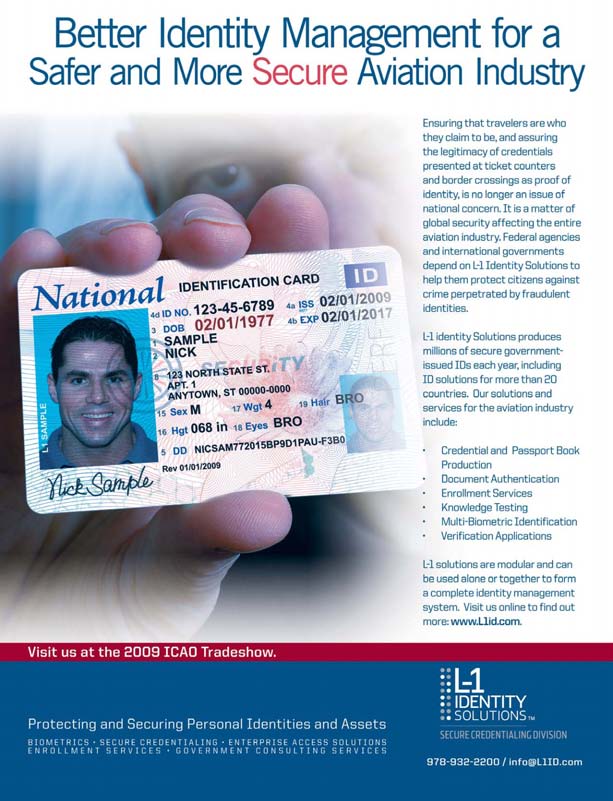
Whenever questions are raised about national ID schemes like REAL-ID or PASS-ID, their more public-relations savvy proponents are always quick to say, “But of course this isn’t a national ID card”.  The same goes for L-1 Identity Solutions, the prime drivers license, ID card, and ID and biometric database contractor, aggregator, and data miner for California and the majority of other states (and keynote presenter at ICAO’s upcoming Symposium on Machine Readable Travel Documents next month in Montreal).

So we were interested to see how L-1 describes its products to its customers in this full-page ad on the back cover of the latest issue of ICAO’s Machine Readable Travel Document Report:

But of course, this isn’t a national ID card.

May 14 2009

California DMV plans crackdown on “look-alikes”

Has anyone ever looked at your face and mistaken you for someone else?

If so, and if you live in California, you could be a victim of a proposal by the California Department of Motor Vehicles which is now under consideration in the state legislature.

At a hearing yesterday (May 13, 2009) before the Assembly Budget Subcommittee No. 5 on Information Technology/Transportation, the Director and Chief Information Officer of the DMV pleaded for more money (in spite of the desperate state budget crisis) to hire a contractor to digitize and store the photographs taken for every California drivers license or state ID, and then use “biometric” facial recognition and matching software to compare each new photo of an applicant for a license or ID with every photo in the database. (The DMV proposal next goes before the Senate Budget Subcommittee No. 2 on Resources, Environmental Protection, Energy and Transportation on Wednesday, March 20th.)

If the computer thinks your picture looks like any other picture in the database, both you and the other person whose photo the robot thinks looks like yours would be placed under suspicion of fraud, identity theft, or worse. Read More

Mar 18 2009

Air France puts digital fingerprints in RFID boarding passes

Yesterday (just in time for tomorrow’s planned strike by French air traffic controllers, which is expected to force the cancellation of many of their flights), Air France began a public beta test of what they are calling a “smartboarding” card, as depicted in this video (and third-party videos in English and another in French) and photos and as described in this press release:

This new system is a world first. With a personal card which contains the latest biometric technology (encrypted fingerprints), RFID (radio frequency identification) and thermal printing (the back of the card can be reused up to 500 times), these passengers will be able to board through a dedicated portal whenever they choose.

Developed together with Citizengate, the smartboarding® service has 4 stages:

1. In a special office at the airport (Paris-Charles de Gaulle Terminal 2F), customers can obtain their personal smartboarding® card in just a few minutes which is immediately operational. During registration, all the customer’s identity information (surname, first name, Flying Blue membership number), as well as their encrypted fingerprints is transmitted to the smart card. This registration stage is only carried out once and no files are kept by Air France. Read More